
The Union Budget 2026-27 was presented by the finance minister Nirmala Sitharaman today in Lok Sabha, marking her ninth consecutive Budget speech. In a comprehensive speech that combines the desire for reforms with the insistence on fiscal discipline, the Finance Minister disclosed a roadmap that aims to intensify India’s growth momentum while also integrating equity, productivity, and resilience.
With the world economy contracting, the situation being unstable due to geopolitics and the pandemic’s after-effects, the Union Budget this year seems more like a marathon strategy to pave the way for the next decade than a fiscal sprint a strategy that is based on structural reforms, targeted allocations and policy continuity.
Three Kartavyas: Foundation of the Union Budget
The Union Budget 2026-27 is built around the idea of three kartavyas (duties), which is a plan that depicts the government’s economic and social outlook for the coming year:
1. Accelerating economic growth
2. Developing human resources
3. Ensuring inclusive development
This storyline does not only provide relief packages but also the long-term aspirations including employment generation, availability of quality healthcare and education, and greater involvement of socially and economically marginalized sections in the country’s growth process.
Image source: Union Budget
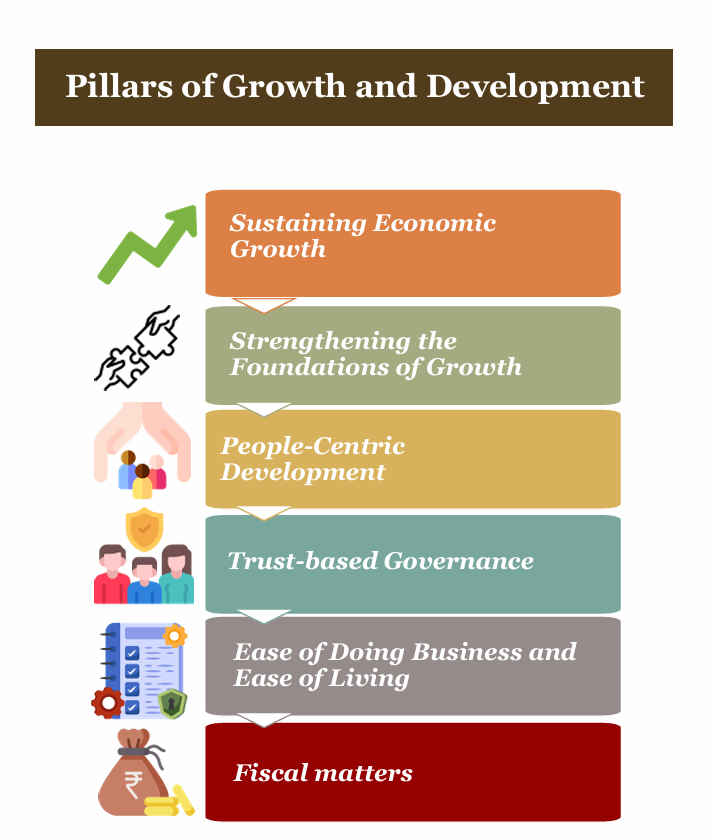
Fiscal Numbers: Consolidation Without Contraction
Among other areas of the Union Budget, the fiscal framework continues to be one of the most closely monitored issues by the public and the markets i.e. how the government balances its spending without losing its capacity to maintain macroeconomic stability.
Total Budget Outlay
The estimated total expenditure for the FY 2026-27 amounts to ₹53.5 lakh crore keeping the nature of the strategy a mix of continued commitment to various key development programmes and adherence to fiscal prudence.
Capital Expenditure
Capital expenditure, which is a major contributor to growth and productivity, has been given a rise of almost 9% to ₹12.2 lakh crore for the upcoming financial year. The continuation of this policy of capital expenditure undoubtedly reflects the government’s desire to create sustainable infrastructures and stimulate economic growth.
Fiscal Balance
The Government once again emphasised its commitment towards the path of fiscal consolidation and its aim to keep the fiscal deficit on a declining path without the risk of losing the growth potential. Several economic analysts stated that such a balancing act is quite a challenging one especially in the light of both international uncertainty and the requirement of domestic investment.
- For FY 2026-27, the government has confirmed its intention to gradual fiscal consolidation.
- The fiscal deficit is estimated at 4.3% of GDP continuing the downward path from previous years.
- The debt-to-GDP ratio is expected to decrease gradually on the way to the medium-term goal of 50±1% by 2030.
This approach allows the government to support growth without overstretching its balance sheet. For households and businesses, fiscal discipline matters because it helps keep inflation and interest rates in check, directly influencing loan costs and long-term savings.
Tax Policy: Stability With Targeted Tweaks
Taxation is still one of the most impactful components of the Union Budget that touches every person and business across the country.
Continuity in Income Tax
While slabs remain unchanged, the Budget introduces significant compliance relief and procedural simplification. The government seems to be giving more weight to stability rather than handing out heavy tax reliefs, instead, the emphasis is on simplifying the tax landscape along with compliance procedures.
Staggered Filing of ITR
In fact, one of the useful things that were revealed is that income-tax return filing will be done in a staggered manner, so the deadline gets extended to 31st July for different categories of taxpayers. Compliance thus becomes less of a hassle and taxpayers get some more time to organise their returns.
Non-Resident Incentives
As a part of initiatives to bring in global talents and investments, the Union Budget extends the proposal for five-year tax exemption for non-resident suppliers of capital goods and tooling in bonded manufacturing zones. The idea behind this is to position India as the top choice for foreign skilled professionals and the import of specialised inputs in manufacturing.
The Trade-off: Fiscal Discipline Over Short-Term Relief
While the Budget prioritises fiscal discipline and long-term investment, it offers limited short-term relief to middle-income households facing inflationary pressures. The absence of direct consumption stimulus suggests a deliberate policy choice that may weigh on near-term demand but strengthen macro stability.
Growth Engines: Infrastructure, Manufacturing and MSMEs
The Union Budget 2026-27 highlights the key growth drivers of India over the long term, infrastructure, manufacturing, and small and medium enterprises (SMEs).
Infrastructure Push
Just as was anticipated, infrastructure maintained its dominant position. With the resulting increased capex allocation, the following will be supported:
- Roads and highways
- Freight corridors and rail expansion
- Urban infrastructure projects
Besides increasing the physical capacity, such investments also generate employment and reduce the costs of logistics in the long run.
Manufacturing Boost
Union Budget continues to upgrade Indias manufacturing ecosystem by way of both policy measures and financial incentives:
India Semiconductor Mission 2.0 received continued and expanded support aimed to drastically reduce semiconductor imports, and simultaneously develop domestic production capacity.
Besides, industries such as biopharma, electronics and AI were given separate budgets to help them become self-reliant and use new technologies.
MSMEs, which are major providers of jobs, would be assisted through various schemes such as increased flow of credit and a ₹10,000 crore MSME growth fund plus ₹2,000 crore top-up to Self-Reliant India Fund which are both aimed at scaling and formalization.
Social Sector
The Union Budget 2026-27 has a major focus on people-centric spending, especially in those sectors which determines the country’s productivity in the long run.
Health Sector
Along with the five medical tourism hubs, greater health infrastructure allocation and mission-oriented programmes aimed at bettering access and affordability were announced.
Education and Skills
One aspect of this Budget that stood out was its strong focus on employability through education:
- Setting up of AVGC Content Creator Labs in secondary schools and colleges
- A girls’ hostel in Higher Education STEM institutions in every district.
- Broader skill programmes that align academic learning with workplace needs
Focusing on educational outcomes and new skills, the Union Budget is basically matching public expenditure with the gains in productivity that will happen over the long-term.
Agriculture & Rural Economy: Tech Meets Tradition
In order to modernise agriculture and strengthen rural livelihoods, the Budget has launched Bharat Vistar a multilingual AI-driven platform aiming at democratizing agricultural knowledge across various regions through application of the most recent technology.
On one hand such agricultural tools and on the other hand the already existing support networks have a huge potential to increase the productivity of small farms and thereby also expand farm supply chains.
Inclusion and Social Equity
Social inclusion continues to be a key theme in this Union Budget with proposals that aim at enlarging opportunities and lowering inequality:
Special development schemes for women, youth and disadvantaged groups
Measures to assist people with disabilities in leading lives of dignity In a changing economy, such focused interventions are a way to ensure that growth is equitable
Trade, Investment and Regulatory Reforms
The Union Budget was designed with several measures to enhance Indias appeal as an investment destination for both foreign and domestic:
An increase in the investment limit of persons resident outside India under certain schemes thus allowing for global capital flows.
A rationalisation of import duties on key inputs to help manufacturing cost competitiveness.
Long-term investment attraction through tax holidays and exemptions for strategic sectors.
The above measures are aimed at positioning India as a dependable and reliable destination for both equity and FDI.
Financial Markets and Capital Sector
The Union Budget did not unveil any direct market stimulus measures. At the same time, higher STT on derivatives signals a calibrated tightening rather than outright stimulus. However, there are few worthy reforms that deepening capital markets, measures to simplify compliance and reduce litigation risk, and regulatory clarity for digital asset frameworks in the offing are worth mentioning. This mixed approach is supportive of investor sentiment and at the same time, it prevents the markets from getting distorted too much.
Environment and Energy Transition
The Union Budget also gave some thought to climate change and sustainability. Energy transition projects received a hefty investment of ₹20,000 crore which facilitated initiatives like renewable adoption, carbon capture technologies and low-emission industrial processes among others. Green growth is also about preparing the Indian industry to be competitive globally in the future.
What This Means for Citizens and Businesses
The Union Budget 2026-27 offers a mixed bag of continuity and reform:
For the households, the continuing use of consistent tax regime and the simplification of compliance has made financial planning a lot easier.
Businesses benefit from additional capital expenditure, rationalised duties and ecosystem-level reforms which transition the business operations towards more efficient functioning and also open up new avenues.
For youngsters and students, education initiatives that are more skills, focused will help them align better with evolving job requirements.
All these points reveal the main theme that is just being consistent: well-planned methodical approach to growth strategy instead of short-term stimuli.
Union Budget in Retrospect: A Strategic Blueprint
On revisiting the Union Budget speech and live updates, certain points can be recognised easily:
- Giving first priority to long-term investment rather than short-term fixes
- Maintaining overall fiscal discipline with only a few areas for expansion
- Bringing technology, skills and equity into the fold of the development agenda
This Union Budget may not immediately delight all stakeholders, but at the same time, it sets out a framework for steady growth, stronger institutions and wider participation in Indias economic journey.
Conclusion
The Union Budget 2026-27 does not appear to be the most headline grabbing, but it could, without doubt, a strategy that prioritises balance sheet strength over immediate political dividends. By means of carefully determined capital spending, forward looking reforms and a focus on human capital, it tries to find a balance among the necessities of growth, inclusion and stability.
For citizens, businesses, and investors alike, this Union Budget provides a predictable, forward-looking foundation, one designed not just to navigate the present, but to build resilience for the future.
The Union Budget 2026-27 is less about winning applause and more about enforcing discipline, a choice that may test patience today but could define stability tomorrow.