
Saving six months of expenses in an emergency fund has been the one piece of advice that personal finance gurus have repeated for decades as if it was the absolute truth. You can find it literally anywhere: blogs, podcasts, and social media discussions, often being presented as the very foundation of being financially responsible. We are asked to obey the rule and then tranquillity of mind will ensue.
However, in 2026, many people who take this advice may still feel financially immobilized. They postpone investing, have a hard time accumulating wealth, and even though they do everything right, they experience money related anxiety all the time. This paradox raises a significant question for contemporary personal finance: is the six-month emergency fund concept still valid or has it become an outdated personal finance myth?
This article does not argue against emergency savings. Emergency fund in fact, should stay as an integral part of one’s finances. What deserves reconsideration is whether everyone needs to save six months of expenses or if a more flexible, data-driven emergency fund strategy would be a better fit in today’s economy.
Where the Six-Month Emergency Fund Rule Came From
To understand why this has rule became so popular, we need to go back and look at the financial environment in which it was originated. The idea of keeping money aside for six months of expenses is not something that just came about out of the blue. It was shaped by the financial conditions of an earlier era.
In those days, jobs were pretty safe and of long duration, as well as stable. Most households were able to get along on just one predictable income. Credit was more difficult to get, and if you were to use it, it would be costly. Investing was complex and largely inaccessible to every individual. Insurance coverage was limited and was usually insufficient. Given that kind of environment, having a huge amount of cash was not only logical but it was also a necessary thing.
In such a case, cash savings were the most important form of financial protection. If anyone lost a job or faced unexpected medical expenses, cash savings were in most cases the only safety net available. Saving up several months’ worth of expenses was seen as a simple and effective way of having a buffer against the uncertainty.
Most importantly, this rule was never meant to be universal. It was intended as a guideline, adaptable to individual circumstances. Over time, the subtlety was lost, and the six-month emergency fund turned into a financial “rule” instead of a guideline meant to adapt to individual financial needs.
Why the Six-Month Emergency Fund Feels Unrealistic in 2026
Fast forward to 2026, and the financial landscape has changed dramatically. The cost of living has risen faster than incomes in many parts of the world. Housing, healthcare, education, and insurance premiums now consume a much larger share of monthly income than ever. At the same time, financial obligations are arriving at an earlier age, thus giving less space for creating large cash reserves.
Saving six months of expenses has become a major challenge for many households as it requires setting aside a considerably large amount of money often several lakhs or tens of thousands. This creates real friction in personal financial planning.
Firstly, investing gets delayed. Many people delay the process of wealth creation because they feel the need to first complete their emergency fund. As a result, they miss out on valuable years of compounding. Secondly, motivation decreases. A goal that seems too far away can be demoralizing, thus making people more likely to give up saving altogether. Thirdly, unutilized cash becomes a psychological burden, especially when inflation quietly eats away at its value, making the money feel wasted rather than secure. Consequently, the advice that is supposed to provide financial security is often causing more stress and slowing down long-term progress.
The Problem with One-Size-Fits-All Emergency Fund Advice
The real issue with the six-month emergency fund rule is not the figure itself. It is the presumption that everyone has to deal with the same level of financial risk. In reality, risk varies widely. Job stability differs dramatically across professions. A government employee, a corporate professional, and a freelancer operate in entirely different income environments. Household safety nets also vary. Some people have dual incomes, comprehensive insurance, and family support. Others rely solely on their monthly pay check.
On top of that, expenses are different as well. Some households have the ability to cut discretionary spending immediately in case of a crisis. However, there are others whose budget is mainly made up of non-negotiable items such as EMIs, school fees, or ongoing medical costs, which leave almost no room for adjustment.
Imposing the same emergency fund goal on all these scenarios without considering their contexts is like ignoring people’s different lifestyles. It treats very different situations as if they were the same, which is bound to result in poor financial decisions.
What the Data Suggests About Emergency Savings
When looking at the data instead of just rules of thumb, the reality is a lot more complex. The evidence keeps on pointing to the rapid rise of the financial resilience with the first layer of savings but as the emergency funds get bigger the benefits slow down.
According to the U.S. Federal Reserve’s Survey of Household Economics and Decision making, only about 55 percent of adults report having three months of emergency savings, and far fewer have six months or more. However, the same survey shows that households with even modest savings are significantly better able to handle unexpected expenses and report lower financial stress.
Vanguards research on financial well-being backs up this conclusion. Their findings show that emergency savings of roughly $2,000 allow a household to gain a great deal of financial stability and confidence. After that point, while the savings still do help, the benefit per each additional dollar saved decreases. The leap from zero savings to a small emergency fund matters far more than the leap from three months to six months.
Consumer finance data further reinforces this point. Research from institutions such as Bankrate shows that many financial emergencies arise from immediate, short-term disruptions such as medical expenses, urgent repairs, or temporary income gaps, rather than prolonged job losses. These situations typically reflect near-term liquidity challenges rather than extended financial crises.
The data suggests a clear conclusion: emergency savings are most powerful at the beginning. The first layer provides the greatest protection. Beyond that, returns diminish.
The Hidden Opportunity Cost of Oversized Emergency Fund
Every financial decision involves trade-offs. Money set aside in an emergency fund is money that is not being used to generate returns. Large emergency funds do not compound like long-term investments. They do not reduce high-interest debt. Over time, inflation quietly reduces their real purchasing power. While emergency savings provide security, excessive cash holdings can slow wealth creation.
This is especially relevant for young professionals and mid-career earners. These groups benefit most from long investment horizons. Parking too much money in cash for safety can unintentionally delay financial independence. The point is not whether or not to save for emergencies. It is whether the size of the emergency fund aligns with actual risk.
A Smarter Emergency Fund Strategy
Modern personal finance Favours flexibility over rigid rules. Instead of targeting a single number, a layered emergency fund strategy allows you for better capital efficiency.
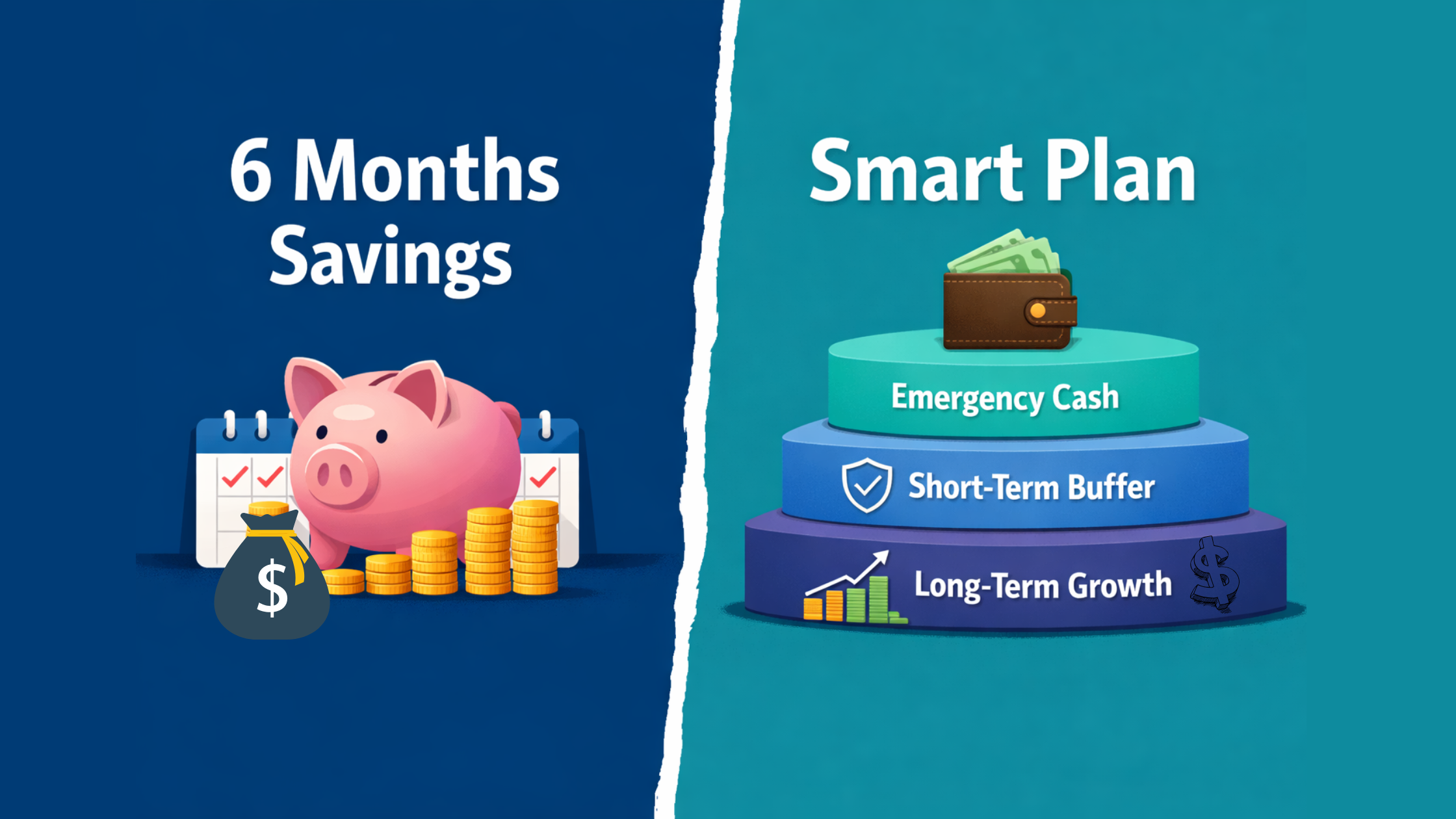
Immediate liquidity provides peace of mind and covers small, unexpected expenses. A short-term buffer helps you to absorbs temporary income disruptions. While, additional backup options, such as access to credit or liquid investments, offer secondary protection. Together, these layers create financial resilience without locking away excessive capital. Instead of concentrating the effort on meeting a fixed standard, this approach focuses on building a system that adapts to real-world scenarios.
Why Risk-Based Emergency Planning Works Better
A more effective way to plan an emergency fund is one should evaluate your own personal risk. Income stability, dependents, insurance coverage, and employability all play a role.
Suppose a person who has a stable job, very strong health insurance and several sources of income; such a person would probably be quite safe with a small emergency fund. Whereas, a person running a small business, freelancer, or single parent with a dependent might reasonably need a larger emergency fund. Risk-based planning transforms emergency savings from a restrictive rule into a supportive tool.
Insurance as a Critical Part of Emergency Planning
Insurance significantly reduces the need for large emergency fund. Health insurance limits medical shocks and Term insurance serves as an economic support for the dependents. Disability insurance safeguards income.
Without adequate insurance, people often attempt for self-insure by holding excessive liquid cash. This approach is costly and inefficient. A well-insured household can afford for a more optimized emergency fund without having to compromise safety.
When Six Months of Emergency Savings Still Makes Sense
The concept six-month emergency fund is not inherently wrong. It remains appropriate for those individuals having volatile income, limited insurance, single-income households with dependents, or small business owners facing uneven cash flow. Saving for six months of expenses is not the issue. The real issue lies in treating that number as a universal formula for financial security, instead of adapting it to individual realities.
Conclusion: From Chasing Numbers to Building Financial Resilience
The purpose of an emergency fund was never to hit a certain number. In fact, the concept has always been about being prepared and having peace of mind. In 2026, financial security refers to having adequate amount of liquid assets, sufficient insurance policies, a planning approach that allows changes, and a risk assessment that is grounded in reality. Instead of wondering whether you have enough savings to cover your expenses for six months, consider whether you are equipped to handle the most probable financial disruptions in your life. Real financial confidence does not come from rigid rules. It comes from readiness.